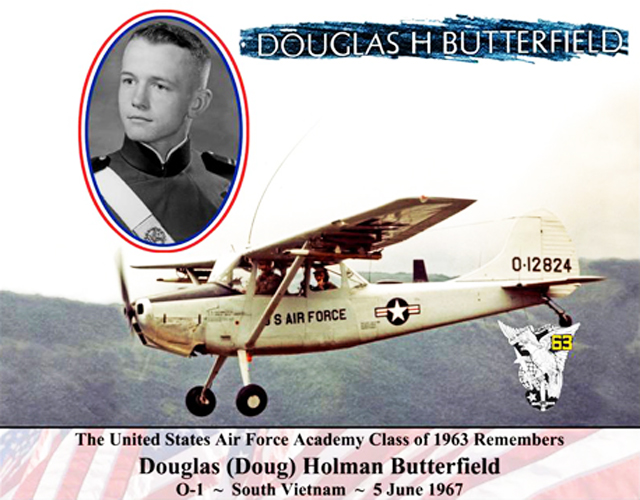
Doug graduated from high school in Vista, CA, in 1958. He lettered in football, tennis, and earned 2 in wrestling where he captained the team his senior year. He also lettered in football during his year at Palomar Junior College before coming to the Academy.
According to Bob Schultz, a close friend in high school, "He (Doug) played one year of Junior College football and was a starter at linebacker. He was small but a tough cookie. Doug was CA State Wrestling Champion in the 154-pound class. He was a straight A student and President of the Senior Class and Student Body." Doug excelled academically at the Academy as well, earning a spot on the Superintendent's Merit List all four years with something like a 3.97 GPA. He graduated 8th in the class and went directly to grad school at Purdue. Excelling militarily, as well, Doug was one of the few in our class who served as a Cadet Group Commander.
After earning a master's degree at Purdue, he began UPT at Williams AFB, AZ, in March 1964. After earning his wings, he stayed in the Phoenix area to check out in F-100 Super Sabres at Luke AFB.
Doug was an F-100 pilot when he left for SEA in August 1966. He appears to have flown most of his combat tour as a fighter pilot, reaching 455 flying hours in F-100s after completing UPT in March 1965. The Air Force had a requirement to provide qualified fighter pilots to be Air Liaison Officers (ALOs) assigned to major Army ground combat units. In March 1967, Doug was chosen to be such an advisor with the Army. He likely got an in-country checkout as a FAC in Cessna O-1 Birddogs and was assigned as an ALO/FAC to the 1st Air Cavalry Division headquartered at An Khe in the central highlands of South Vietnam.
He would advise Army commanders on the availability and use of Air Force aircraft to support the division. When flying a Birddog, he would look for enemy activity or signs the enemy might be moving into areas that would threaten the division. FAC visual reconnaissance missions normally covered an assigned area in a somewhat random manner without any prearranged flight plan. Normal FAC altitude in-country was 1,500 feet to stay above the effective range of small arms fire. FACs flew higher over .50 caliber machine-gun threat areas, or down to treetop level if there was something important to check out. Birddogs carried enough fuel to fly between 3 and 4 hours.
On 5 June 1967 barely two months before the end of his combat tour, Doug took off on such a mission. He made his normal check-in by radio with controllers at the end of one hour. He did not check in at the end of the second hour. Contact could not be reestablished with Doug, so a search began. The crash site was discovered only 5 miles from An Khe. It appeared Doug had been shot down without having a chance to make a May Day call.
Being a FAC was a risky job. Doug was one of nearly 300 killed during the War in SEA.
"I remember Doug, as a light hearted individual, who didn't, sweat, the small stuff. He did very well in pilot training." Roger T. (Tom) Giles, UPT, 65-F, Williams AFB, AZ