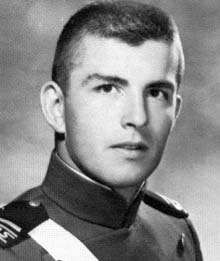
Leslie George Denend
"Les"
Biography as of Mar 19, 2026
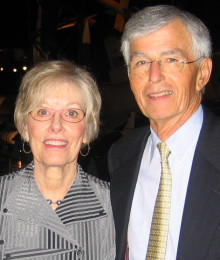
Les was born in San Francisco, California on March 6, 1941. He married his college sweetheart, Judy Costello, Loretto Heights College in 1963. They have two children, Kimberly (1965) Stanford BA in economics and MBA, who married her high school sweetheart Michael Guthrie, and she and Mike have three children. Our son Christopher (1967) Stanford BEE, who married Lyn Thayer, and they have two children. Judy and Les have five grandchildren: Michael (Kim,1995) who is closing in on a graduate degree from Arizona State; Jessie (Kim, 1998) BA, UCLA, Theater Film and TV; Kate (Chris, 1999) BA Pomona, Biology, NCAA swimmer; Clara (Kim, 2001) BA, (Honors) English, UVA; and Emma (Chris, 2001) BA (Honors) Classics, Occidental. Surprised by an appointment to USAFA in 1959, Les abandoned his plans for engineering at Stanford and joined the 5th class at the nation’s newest service academy. President John F Kennedy spoke at his graduation and presented diplomas to the Class Distinguished Graduates. When he asked Les where he would go next, Les said to study Economics at the University of Bonn (West) Germany under a Fulbright Scholarship. Les thought the President seemed surprised, but then smiled in approval. Upon his return to the US following the Fulbright, Les entered pilot training in Arizona at Williams AFB. He graduated first in his class and received the awards for the outstanding graduate in flying, academic and military training. His first assignment was as an instructor pilot in the T-38 at Williams. After three years of flying with students and teaching in the academic program, Les received an assignment to the RF-4C. Following a six-month check-out and orientation in the basics of reconnaissance, in Mountain Home, Idaho, Les reported to Udorn, Thailand. He completed 194 combat missions, receiving the Distinguished Flying Cross and fourteen Air Medals during his twelve-month combat tour. Les returned to the US to begin a two-year MBA course of study at the Stanford Graduate School of Business. He transferred to the PhD Program after the first year. He completed his field exam for the PhD in 1974. He competed for and won a White House Fellowship and reported to the White House that fall. His assignment was the Executive Assistant to the Director of the President’s Council on International Economic Policy. He continued to think about his PhD dissertation. At the completion of the Fellowship, Les joined the Economics Department at the Academy. He completed his dissertation and received his Phd degree. He taught the basic Economics course to sophomores the first year and then advanced Macroeconomics and Econometrics courses to upperclassmen the second. In the spring of 1977, he was invited to join Zbigniew Brzezinski’s National Security Council Staff. Les served in the Global Issues Office which had responsibility for nuclear proliferation, conventional arms transfers, and President Carter’s human rights policy. After two years he was appointed Special Assistant to The Assistant to the President for National Security Affairs and moved to the front office. He worked closely with Zbig and at the conclusion of the Carter Administration, Les received the Arthur S. Fleming Award as one of the ten outstanding young men and women in the federal service. With the election of Ronald Reagan President, Les moved to the Pentagon as one of four colonels advising Joint Chiefs of Staff Chairman General David Jones. Les’ areas included Middle East Issues, the Defense Budget, Intelligence matters and Space. Upon General Jones retirement, Les was invited back to the White House to work on economic policy in the Office of Policy Development. At the conclusion of a twenty-year Air Force career, Les retired. Having been promoted early twice, he was able to serve as a colonel for the required three years to retire as an O-6. He joined McKinsey and Company. He co-led the Firm’s fledgling aerospace and defense practice while developing broad-based industrial clients. In 1986, he moved to the San Francisco Office to continue his work. Three years later he left McKinsey to join 3Com Corporation in Silicon Valley. He assumed leadership of the Enterprise Systems Division and founded the Federal Systems Division, a new effort to improve and expand 3Com’s business with the various agencies of the US government. He later served as Executive Vice President for product Operations as 3Com made the transition to a global supplier of end-to-end networking services and equipment. Les was recruited from 3Com to become the Chief Executive Officer and President of a publicly traded company, Vitalink Communications. In the rapidly changing networking part of corporate computing, Les found a merger partner and concluded the negotiations to join Vitalink with Network Systems in Minneapolis. After a year-long post-merger transition, Les left Network Systems to join Network General Corporation in Menlo Park, California. After six months with overall responsibility for products, Les was asked by the founder, to take over for him as CEO. Leading Network General was the most fun Les had as a business executive. Over the next three years, Revenue tripled, and the market capitalization increased by ten times. Network General was acquired by McAfee in December of 1998. Les took NGC’s responsibility to the community seriously, overseeing the philanthropy program started by the founders. He participated in the American Leadership Forum, and later became its chair. His most enjoyed volunteer role was as the chair of the 1986 Second Harvest Holiday Food Campaign. Following the sale of NGC, in January 1999, Les conducted the most in depth review of his career since the decision to retire from the Air Force in 1983. Considering health concerns and his growing corporate board service, he decided not to take another company-specific corporate leadership position. He would become a full-time corporate director. He had joined the United Services Automobile Association (USAA) Board in 1996 and was in line to assume a major board committee chair, and later to become the lead outside director. He was also a member of two other public company boards. He also wanted to accept Stanford’s GSB offer to co-teach the MBA course in Entrepreneurship as a Stanford Lecturer. As the reunion for the 50th graduation anniversary approached, he was asked to serve on the gift committee. He took on responsibility for fund raising for the class gift. The committee was able to present an annuity to the Academy of over a million dollars. Les joined the board of the Air Force Academy Foundation as a Founding Director and became the founding chair of the Nominations and Governance Committee. In 2019, the Association of Graduates named him a Distinguished Graduate. In 1990 Les received his first pacemaker for heart arrythmia. Over the next seventeen years Les was the recipient of multiple pacing solutions for a weakening heart. Finally in 2008 he went on the heart transplant list. About a month later, he received a new heart at Stanford hospital. His donor a retired Coast Guard officer, sixteen years younger than Les and a Northern California golf pro had a massive stroke. His experience with his new heart has been uneventful. Over the next sixteen years Les served on over fifteen boards or Advisory Councils of some private but mostly public companies to include: Proxim; Berkeley Systems; Exponent; Adaptive Broadband; Vitalink; Informix; Network Systems; USAA; McAfee; Rational Software; Network General; and Verifone. In 2015 at age 74, Les retired from his last board. Since then, Les and Judy have traveled watched their grandchildren grow-up, mature and complete their college education. In 2019 they moved to The Vi, a senior living community on the Stanford campus. March 2026