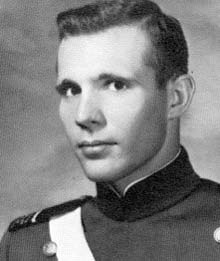
George Wilbur Pollitt

Biography as of Mar 19, 2013
George Pollitt graduated from USAFA in June 1963 and reported for Pilot Training to Reese AFB, Lubbock, TX in August 1963. He washed out on instruments and was reassigned to Navigator Training at James Connally AFB in Waco, TX. After graduating from Navigator Training, he reported to Minot AFB, ND in May 1965 to navigate KC-135s. After completing Survival School in Reno, NV and Crew Training at Castle AFB, Merced, CA, he returned to Minot to navigate. He spent three years there with extended TDY tours at Eielson AFB, Alaska; Anderson AFB, Guam; Kadena AFB, Okinawa; and U-Tapao and Takhli in Thailand.
In August 1968, he was assigned to McCoy AFB in Orlando, FL, where he navigated the KC-135Q tanker, refueiling the SR-71. Training was conducted at Beale AFB, CA. His extended TDY assignments were to Kadena AFB and twice to Torrejon AFB near Madrid, Spain. Between the Minot and McCoy assignments, he flew 35 combat missions.
In August 1969, George resigned his commission and went to school. He received a BSE in Mechanical Engineering from Florida Tech University (now University of Central Florida) and an ME degree in Aerospace Engineering from the University of Florida.
In September 1971, George went to work at the Naval Ship Engineering Center (NAVSEC) in Hyattsville, MD as a Mechanical Engineer and Engineer in Training. He learned naval architecture, helping to design Fleet Tugs and a Marine Corps hovercraft, known as the LCAC, and he programmed Tactical Decision Aids for Mine Countermeasures (MCM) planning and tactics. These Aids were used to plan the MCM operations that cleared the appoaches to Haiphong, DRV, after the US Navy mined Haiphong Harbor and the rest of the DRV littoral. The mining and the MCM operations were negotiating points to get our POWs back from North Vietnam. Still in training, he worked for the Naval Materiel Command (PM-19) to coordinate support for the minesweeping ships and helicopters in Operation End Sweep. He later worked at the Naval Ship Systems Command to plan the development of a new minehunting system for future MCM Ships. He decided that he would devote his efforts to mine warfare, an important, but neglected, warfare area for the US Navy.
In August 1973, having finished training, George returned to NAVSEC and became the Technical Agent for two developmental minehunting systems: (1) the Mine Neutralization Vehicle (MNV) System and (2) the Shipborne Minehuning System (SMS). The NMV was an early Remotely Operated Vehicle (ROV), which was used to inspect minelike objects and, if they were identified as mines, to neutralize them by cutting mooring line or dropping an explosive charge near bottom mines. ROVs are common today, but in 1973 there were only a handful in existence. The MNV system was installed as the AN/SLQ-48 on every MCM 1 Class and MHC 51 Class ship that the USN built during the '80s amd '90s. The SMS was a high-resolution minehunting sonar. It was respecified and redesigned to be towed through the hull of the MCM 1 and MHC 51 Class ships and was later installed as he AN/SQQ-32.
In October 1975, George transferred to the Naval Coastal Systems Center (NCSC) in Panama City, FL, where he worked as an operations research analyst on MCM tactics and MCM Force Level studies. He developed MCM tactical theory, programmed Tactical Decision Aids, and analyzed the tactical needs of the MCM 1 Class ship, which was being designed at that time. He also contributed to the Force Level Analyses that the Navy used to decide how many MCM 1 Class and MHC 51 Class ships and MH-53E helicopters to buy.
In June 1980, George transferred to Commander, Mine Warfare Command (COMINEWARCOM) in Charleston, SC, as the MCM Analyst. This Flag command controlled, among other things, the tactics and doctrine for MCM ships and Airborne Mine Countermeasures (AMCM) helicopters. Main duties were developing integrated MCM tactics for the combined employment of surface minehunters, AMCM, and Explosive Ordnance Disposal (EOD) divers and analyzing exercises and operations to determine the effectiveness of equipments and the tactics. He formed and chaired an MCM Operations Tactics Group (OTG) that coordinated the development of tactics and their validation in exercises. During this period he analyzed about 30 exercises and equipment tests. Also during this period, he became the Command's Adviser for Research and Analysis and represented the Command for R&D programs and senior studies. Later positions included Assistant Deputy for MCM Operations and Head of Analyses.
During the summer of 1988, George went to Bahrain as the Analyst for Operation Tasking Kingfisher. As a result of USS Samuel B. Roberts' being nearly sunk in April of 1988 by an Iranian mine, the CNO established Operation Tasking Kingfisher to evaluate options for protecting Navy ships from mines. The project evaluated high-resolution sonars and optical sensors that might be employed to detect mines in the paths of combat ships. Tests were conducted in the Gulf onboard USS Halyburton. The outcome was a modification to ASW sonars that could detect mine-sized objects at sufficient range to enable mine avoidance.
George helped with the planning for Desert Saber, the planned amphibious assault of Kuwait. In early June of 1991, he led a team of officers and civilians that evaluated in the North Arabian Gulf (NAG) the MCM sweeping and hunting performed by US and UK sweepers and hunters to clear the mines laid to prevent an invastion. He briefed the evaluation results to COMIDEASTFOR on 30 June 1991, the day the Allied MCM forces declared the approaches to Kuwait open.
In January 1993, George became COMINWARCOM's first Technical Director. In July 1993 he moved to Corpus Christi, TX with the Command.
Other COMINEWARCOM work included development of TACMEMOs and TACNOTES; managing the Command's Tactical Development and Evaluation program; preparing new NWPs; maintaining existing NWPs; developing exercise planning and analysis procedures; participating in wargames as sponsor, control, and assessment agent; chairing Mine Warfare S&T Round Tables for the OPNAV sponsor; helping to establish a mine warfare curriculum at the Naval Postgraduate School and providing lectures and thesis mentoring; and participating in MCM studies with the Naval Studies Board and Naval Research Advisory Committee.
George retired from Civil Service in October 1997 and reported to the Johns Hopkins University Applied Physics Laboratory (JHU/APL) as a mine warfare analyst. He has worked at JHU/APL since thalt time on MCM programs. Among his projects were: the Maritime 9-11 Study, in which a team of terrorists attacked the US using mines in a way that affected the economy significantly - this was briefed over 60 times to senior audiences and resulted in a route survey program being established for military ports; data fusion for enhanced minehunting capability; Route Survey and Change Detection experiments; analysis of the MCM Module for the new Littoral Combat Ship (LCS); OPNAV budget analyses; requirements for Unmanned Underwater Vehicles (UUVs) for minehunting; distribution of minehunting functions among small UUVs for very shallow water (<40') mine clearance; analysis of Future MCM Systems Alternatives; Joint Undersea Superiority Study to establish mining and MCM requirements; MCM in support of Ship to Objective Maneuver (STOM); Mission Area Analysis for an MCM Command and Support Ship; Utility Analysis for autonomy for minehunting UUVs; and Independent Test and Evaluation Agent (IT&EA) for UUVs and Marine Mammal Systems for minehunting.
Both internal and external distribution lists have been established to keep the mine warfare community advised on current mine warfare news. These lists cover about 700 participants, including active duty and retired Flags and senior civilians.
George continues to work as the IT&EA for light-weight UUVs for minehunting in the Arabian Gulf. Two waves of vehicles have been delivered and more vehicles and advanced sensors are being evaluated to enhance the MCM capability for Commander Fifth Fleet.
George is married to Beverly Katz Pollitt, has three daughters - Phyllis, Harriet, and Rebecca - and four grandchildren.