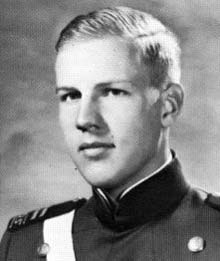
Randolph Smith Reynolds
"Randy"
d 2026

Biography as of Jul 22, 2012
RANDOLPH S REYNOLDS
USAFA Class 1963
Biography
Birthplace: Anniston, Alabama
Date of Birth: 29 June 1941
High School: Anniston High
Appointment: Principal by Congressman Kenneth A. Roberts
Entry Date USAFA: 26 June 1959
No one expected someone from my small high school in Alabama to succeed in getting appointed to the new Air Force Academy on their first try, but one month after graduating from Anniston High School I found myself stepping off a Convair 340 and seeing Pikes Peak and the Rampart Range for the first time. For the few of us young men on that flight the tensions were high and our world was about to make an abrupt change. I had seen photographs of the Academy in a very recent National Geographic but I was not prepared for the size of the place.
Entry in to the Class of 1963 was different than before and different than today. The first upperclassman that I encountered looked to be very old. Like others before me we were yelled at to run to the north end of the AB complex (as it was known in those days) along the terrazzo where a line of several upper classmen in the first summer detail were waiting in ramrod precision and starched and creased kakis. In short order I was standing before George Luck who I later learned had been at West Point where he had run into some academic difficulties, left the Military Academy and a year later was appointed to the new United States Air Force Academy. I was shown how to report, salute, and where next to run that turned out to be a squad of us that was taken down to the barbershop. With upper classmen yelling at us all the time I think I was in a bit of a state of shock when I lost all my hair. We all soon were dressed in Air Force fatigues except two of the 755 of us who were inadvertently issued Army fatigues with U.S. Army sewed over the left shirt pocket. Coincidentally my new roommate, Lee Lyons and I were the two and that began a nine-week basic training that will ever remain with me.
It has always seemed important that my awakening to life as a Basic Cadet would come to serve me in many ways. I was in A Flight of the 30th Provisional Squadron and on the fourth day we were able to march as squadrons to the Honor Court to be officially sworn in; it struck me that I had made it and I would make it to through BCT. I was proud yet very apprehensive of what was to come. When the nine weeks were up I was adjusted to life as a BCT but the next challenge was the return of the rest of the wing and the long haul of days till our graduation some 1400 days away.
Unfortunately I did not have a roommate that first semester in August 1959 as he was injured during football practice, hospitalized and had to leave USAFA. Life in 10th Squadron took on the routine of formations, inspections, academics and atheletics. My second semester Tom McCracken became my roommate and he was academically more prepared than I for at the end of that semester I took a turn out exam in English and of five cadets that took the exam I was the only one who graduated. In essence it was not until my 2nd Class year that my grades began to improve.
After our Doolie year 10th Squadron became 14th Squadron as the number of cadet squadrons increased. The 755 of us who entered nearly doubled the number of cadets in the wing. In the fall of 1961 the number of squadrons grew to 6 per group and I was assigned to 18th Squadron. Those were good years with some special roommates, Joe Coates, Bill Ball, and Owen Lentz. In our senior summer Bill Ball and I went to pilot indoctrination at Craig AFB in Alabama, which put us at an advantage a year later. Our class invited President John F Kennedy to speak at our graduation and with the exception of the top 25 graduates and the bottom man we received our commissions from General Curtis Lemay and diplomas from BGen. Robert F. McDermott. President Kennedy presented diplomas to that special group.
In July 1963 I began Undergraduate Pilot Training at Craig AFB Alabama. We flew T-37Bs and T-33As. The class was made up of both USAFA grads and AF ROTC grads along with two Iranian student pilots. The competition was keen and I ended up first in my class and got my assignment of choice the F-105. Up until then the F-105 had not been assigned to second lieutenants out of UPT. Graduation was in August 1964. My level of excitement about being assigned to the F-105 Combat Crew Training at Nellis AFB was overflowing; after all it was the Air Force's newest fighter bomber. First a group of us went to Stead AFB outside of Reno for survival training then at Nellis we had a class of seven UPT graduates, two of us from Craig and two others who were members of the class of 1963, Jim Hannam and Phil Tate. In February 1965 during the period of conventional weapons delivery training we learned of the use of the F-105 in Southeast Asia and soon that aircraft was the mainstay of bombing missions over North Vietnam. The day Rolling Thunder was to begin I was on a cross country to Tucson, Arizona. My aircraft was on static display next to two F-104s. At one point the crowds were moved away from us and two pilots took to their F-104s to head back to George AFB. We knew something was up.
After completing my gunnery training in May 1965 I was assigned to the 35th Tactical Fighter Squadron with a PCS to Yokota AB Japan. When I arrived the squadron was at Takhli AB Thailand so I was temporarily assigned to the 80th TFS at Yokota. Along with the 36th TFS these squadrons were formerly the 8th Tactical Fighter Wing but had been moved from Itazuke Japan to Yokota in 1964. Each squadron pulled two to three months temporary duty at Takhli flying combat missions. In October I went with the 35th TFS to Takhli for the last of the squadron rotations to Thailand. After that individual pilots rotated to Takhli as we left most of our aircraft there for the war effort. Our other assignment was to sit on nuclear alert at Osan AB, Korea. In my two years there I spent a third of my time at Takhli, a third at Osan, and a third back at Yokota.
Yokota was a large old base and much of the year the weather was marginal VFR. This was the real Air Force and I liked Japan and the other fighter pilots that I came to know. The housing area for Yokota was Johnson AB (Iruma Air Station) just north of Yokota about twelve miles. A year later I met a schoolteacher for the dependent schools and before my two-year assignment was up we had become engaged. Vonna Thompson and I married when we returned to the states.
The air war in Southeast Asia intensified with escalation of the bombing. There are several sources that describe flying combat out of Korat and Takhli in the 'Thud' so I won't elaborate here. There were 'simple missions' and there were complex and more dangerous mission that we flew. I flew three TDY periods, first with the 35th TFS, one with the 357th TFS and one period with the 333rd TFS. A typical mission would be four F-105s with a spare. The frag would arrive late in the afternoon the day before and the pilots assigned to the later sorties would do the basic flight planning for the morning goes. There were five flights per squadron or about twenty-five pilots. Each squadron would fly at least twenty sorties per day. The F-105 was the best aircraft for this particular mission due to the ruggedness of the airframe, the bomb load and our on-deck speed. During the bombing shortage period that I recall was in the winter of 1966 we carried a lot of 3000-pound bombs on the inboard stations. The flights would take off in single ship. The F-105 would be near its maximum takeoff weight. Once airborne and joined up the flight would head towards a tanker rendezvous prior to entering North Vietnam or sometimes Laos.
Each mission was unique in its own perspective but the hard ones were into the Hanoi area. These had to be approved by the Joint Chiefs of Staff hence were called JCS missions. Ingress was either down Thud Ridge, a high narrow range of hills running basically northwest down towards the low lands around Hanoi, or we flew in from the Gulf of Tonkin. If the weather was clear the mission stood a good chance of getting to the target. To my knowledge enemy resistance never stopped a mission but the defenses were intense. My last TDY at Takhli was in the fall of 1966. When I returned to Yokota I had orders to the Air Training Command to fly T-38s as an instructor pilot. At the time I was certain that I would be rotated back to Thailand due to the need for combat pilots. There was a lot going on at the time. A fourth squadron was formed while I was TDY to Takhli and many jocks at Yokota wanted to finish their missions and I missed that opportunity.
The T-38 was a joy to fly and instructing was at first a challenge but later became routine. Not long after arriving at Vance I applied for a second tour to South East Asia, specifically to return to the F-105. That was at a volatile time but the Air Training Command wouldn't forward my requests as I had a two-year commitment to the base. I applied to Test Pilot School but ATC denied that request before it made it up channel. After two years of trying to get around this impasse about assignments I applied for AFIT but was not accepted. However, I was accepted at the University of Arizona for graduate studies. As it turned out in July 1970 I resigned my regular commission, joined the Air Force Reserve and got my MS in Aerospace Engineering.
In 1972 I went to work for MacDonnell Aircraft on the new F-15 program. Although I was assigned to Flight Test my job did not include flying and after two years I took a job at LTV Aerospace in Grand Prairie Texas. This allowed me to get back to the F-105 that was now with the Air Force Reserve in Fort Worth. In 1976 I became a full time Air Reserve Technician and in time worked in aircraft maintenance, operations, and as the 457th Squadron Commander after we got F-4D aircraft. I was promoted to the 924th Tactical Group Commander but after a year I had a short medical grounding that complicated my life.
In 1988 I went to work for NASA in Flight Research at Ames Research Center. One of the modified research aircraft was a C-130. I managed to get a slot for C-130 training from the Air National Guard so that I could participate with the NASA C-130 research missions. My job in the airborne science division made me responsible for the airworthiness of the larger research aircraft. This was to be a time of great expectations for NASA and as research pilot and head of the Engineering and Inspection Branch I found the work interesting. I continued in the Air Force Reserve traveling back to Oklahoma City and Tinker AFB where I worked in the Engineering and Technology Division of the Air Logistics Center.
NASA was caught in the downsizing to balance the budget in 1996. At the end of 1997 our flight operations at Ames Research Center was shut down and most of our large research aircraft were moved to NASA Dryden Flight Research Center at Edwards AFB.
In retrospect flying, NASA missions could be very interesting and the science associated with our 'airborne platforms' was state of the art. One high point for me was receiving the Hugh Dryden Fellowship that allowed me to spend a year in postgraduate studies in physics and remote sensing. That fellowship came to an end when the downsizing began and the following year I transferred to Dryden where I was put in charge of setting up the new Airborne Science program. There were many programs going on at the time including the X-33 development that would have been a test bed for a future single-stage-to orbit space shuttle. These programs along with several others that I was involved with were caught in the budget crunch. After two more years I elected to leave NASA for a position as Associate Dean for the College of Aviation at Embry-Riddle Aeronautical University in Prescott Arizona. I taught and managed academics for the next decade then retired in 2010.
In summary it is clear that the Air Force Academy launched me on my 'Flight Through Life'. Including eight years of active duty, AF Reserve time and tacking on the four years at the academy my total 'blue suit' time in the Air Force was just over 34 years. All my other experiences in industry and NASA were influenced by my experience with the Academy.
I have been married for 45 years. Our daughter Emily is finishing up her PhD in neuroscience and my son Randolph is a project manager for a computer company in Silicon Valley. If I were to do it all over again I would wish one change: to not have left PACAF without finishing 100 missions. It might have made a difference in my assignments and possibly I would have remained on active duty longer.
I have deep affection and thoughts about my experiences at the Air Force Academy. I am quite proud to be part of the Class of 1963. This is undoubtedly the finest group of men with whom I have ever been associated.
35th Reunion (1998): 34 YEARS LATER Perhaps you classmates of mine would be interested in just the “turning” points in my “career” rather than just a laundry list of been there, done thats. There are three significant eras in my professional life separated by eight boring years in the aerospace industry as a systems engineer. So treating this like a triple-decker sandwich, the meat of my adventures begins with the highest high and the lowest low. Each of us has experienced events of joy or trauma, astonishment or inferiority that have molded us and forced us to change directions and even to change our ambitions. I was consumed with the love of flying, especially fighters. Between September 1964 and June 1967 and then between May 1974 and June 1985, I flew F-105s and F-4s on active duty and in the Air Force Reserve. That was my life! Then it ended all too abruptly. At the time I was a full time Reservist, an Air reserve Technician. I really liked being a Squadron Commander with twenty-six jets and a hundred folks under my “command.” I became politically acceptable and boosted into a situation I felt I was not ready for. Within a year my health failed. I was grounded and ill-advised to leave my job for something less demanding. It ended my active duty Air Force career, but I did finish up thirty and a half years as an Air Force Reservist. Three years later in 1988, with my health restored and back on flying status, I went to NASA. I was excited about that and I was a lot wiser after my experiences. Things were good in flight research until the election of 1992. Soon NASA was on the block to be reinvented and emaciated. As of this writing my position is being eliminated. I am sure I will continue to be gainfully employed in or out of government but I am now one of those who swell the statistical ranks of having been downsized. The third and perhaps most influential period for me began the Spring of 1965 when I was assigned to the 35th TFS at Yokota AB, Japan. Over the next two years I spent seven months on a TDY basis at Takhli AB, Thailand. A third of my time was flying combat, a third sitting nuclear alert in Korea, and a third trying to stay current in the dwindling fleet of F-105s in Japan. I was PCSed back to the States in ‘67 to be a T- 38 IP. For a very short time that was a real nice respite. I was newly married to a teacher I met at Johnson AB north of Yokota. My wife, Vonna, grew up on a wheat farm in North Dakota and ended up graduating with a degree in Music Education from the University of Arizona. She has been my helpmate for thirty years and without her....I couldn’t imagine such a world. In 1970 it was to Tucson and the U of A that we went so I could get my master’s degree in Aerospace Engineering so I could be a test pilot, so on and so forth. That had always been my goal on active duty, but the Air Force twice turned down my application to the Air Force Test Pilot School. After six months back in the States I volunteered for a second tour in SEA, but eighteen months later ATC stopped allowing volunteers for second tours to Vietnam and told me I’d have to wait another three years before a reassignment came. I bolted from the Air Force for a while. I finally got back to fly fighters in 1974, perhaps at the end of an era. Vonna and I have managed to get two children through college. our daughter is on active duty with the Air Force and started her service as part of the B-2 test team. Our son is a graphic artist with a degree in history and studio art. He cannot contemplate a military life. The wonderful thing is that from that time as a young fighter pilot in Japan to now, my wife has eagerly shared all this. Where we go next is another adventure together. as of this moment these 34 years are colored by my obsession with “Ad Novos Mundos” and my classmates whom I have sensed were setting the pace; if you weren’t, I felt as if you should be and so should I. Randy Reynolds Colonel, USAFR (not yet retired)