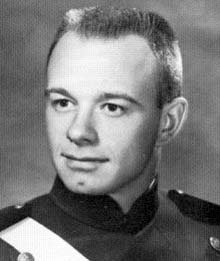
Daniel Lloyd Ringler
"Dan"
d 2026

Service
United States Air Force
Highest Rank
Lt Colonel
Years of Service
22
Combat
Yes
Biography as of Sep 28, 2013
Military History of Daniel L. Ringler, Class of 1963
From a very early age I knew that I wanted to fly someday. My father was a photographer, who in the 1930s to the 1950s, traveled by car from town to town around the USA taking photographs of people and families since many smaller towns did not have professional studios. Many times, when riding in the car with my father, I would put my hand out in the air stream and imagine my hand was an airplane. From that experience I always thought that I would like to be a pilot someday.
I graduated from Forrest-Strawn-Wing High School located in Forrest, Illinois, in 1958 and from there attended the University of Colorado (CU) at Boulder for a year. My aunt, whom I lived with during my high school years in Strawn, Illinois, knew that I was interested in attending the AF Academy as I first tried for an appointment in 1958 without success. Sometime after I started at CU, she personally contacted Representative Leslie C. Arends, the House of Representatives Minority Whip, about me. Congressman Arends was from Melvin, Illinois and may have known my aunt since she had taught elementary school in Strawn for more than 40 years, and these towns were only a few miles apart. My aunt must have had good things to say about me as I won an appointment from the 17th Congressional District to the Academy after completing the entry testing successfully at Lowry AFB, Colorado.
After entering the Academy in June of 1959 and meeting up with my cadet training instructors, I didn€™t know if I was coming or going with all the commands and activities my classmates and I were exposed to. The first thing I remember hearing was €œReach for Colorado and give me 10.€ The €œ10€ of course were pushups. The dorms on the inside all looked basically the same, and it was easy to get lost during those early days.
We were all assigned temporary squadrons. I was assigned to the 12th Squadron initially and then was transferred to the 17th Squadron later. Having just come from Colorado University (CU), being a €œDoolie€ was not easy; especially after the 1st Classmen found out I attended such a close, rival school. The fact that I did have some Air Force ROTC training at CU, probably helped save me during Doolie summer.
My four years at the Academy were definitely life changing and challenging. I truly enjoyed my four years there, and appreciated the fact that I was among a very special, gifted group of people, especially my classmates. A special thanks goes to Gil Merkle, Dick Bunce, Doug Hardgrave, Dick Guild, and John Patton for being outstanding roommates while I was there. They all were a great help to me.
My folks lived in Denver so the Academy was close to home. The fact they owned a nightclub there probably endeared me to my classmates. In addition, some of my best friends from my class lived in the Denver area and had homes there.
Getting back to the Academy from Denver for curfew was always an interesting challenge, especially in bad weather times. Having said that, I was only late once and walked the tours for it in the cold of the Colorado winter.
After graduation and before reporting to pilot training, we had some free time to kill, and my good friend and classmate Robert M. Gilchrest, who was also from the Denver area, and I decided to head to Europe for 30 days. We caught a hop out of Lockbourne AFB, Ohio, to England after visiting my home in Strawn, Illinois for a few days. From there we took a ferry across the English Channel to The Hague, Netherlands. After the Hague we boarded a train to Copenhagen, Denmark, and then on to Munich, Germany. After Munich we went on to Zurich, Switzerland, rented a car, and drove through the Swiss Alps. We ended that drive back at Lausanne, and then took a train to Geneva, Switzerland. From Geneva we went on to Barcelona, Spain, boarded a ferry there and cruised over to Palma de Mallorca. For most of the places we went to we stayed at Hostels or inexpensive but decent hotels. We caught a flight out of Mallorca to Torrejon AB in Spain and then took a hop back to the USA in time for pilot training. This turned out to be one of the best vacations of my life, and it was relatively inexpensive.
As a side note, my classmate, Bob Gilchrist, who went on this vacation with me, was shot down over North Vietnam during October 1966 flying an RF-4C reconnaissance aircraft. I am most thankful he had this wonderful European travel opportunity before his unfortunate and untimely death. He was a dear friend and a great person to be around. He would have gone far in his life. I have missed his friendship for these many years.
Early on while still at the Academy, how did I decide the course of my Air Force career? On our Academy European Cadet trip while in London, I ran into a graduate from the class of 1961 who was there TDY on a C-124 airlift mission. He convinced me that flying large transport aircraft was the way to go in my career, and when I went to Webb AFB, Texas for Undergraduate Pilot Training, my end goal was to go to a C-124 Squadron and fly transports. Then, after my career was over, I could easily go on to be a commercial airline pilot.
During my stay at Webb AFB, I met my future wife on a cross-country training mission to Denver, got married after a few months, did some artwork for my respective training classes (large oil painting of a T-37 and one of a T-38), and lived through the traumatic day and events of President Kennedy€™s assassination in Dallas, Texas. After graduation from my T-37 and T-38 training with Class 65B at Webb AFB, I got my wish to fly C-124s and was assigned to the 3rd MATS Squadron at Charleston AFB, SC in 1964.
Going from flying a sleek, jet-powered T-38 to the huge, prop-driven C-124 was challenging to say the least; however, I was able to overcome this change from jets to props and really enjoyed flying the C-124 and being with the 3rd MATS aircrews.
During that short time I had flying in the C-124 as a copilot, I was able to fly to many exotic places such as Panama, Dutch Surinam, Brazil, Ascension Island, the Azores, the Dominican Republic, Nova Scotia, England, France, Spain, Greece, and Turkey. While in Panama we actually were able to board a Greek freighter and cruise down the Panama Canal, an incredible experience. The Greek captain could not have been friendlier. He was a great host and invited our crew to dine with him. We came back to Panama City by train the next day and later flew back to Charleston.
During the Dominican Republic Civil War of 1965 we transported US personnel and material needed to put down a communist uprising there and save Americans who were there when the crisis began. We learned what it was like to have 37-hour crew-duty days shuttling from East Coast ports to the San Isidro Air Port just outside Santo Domingo. As an interesting side note, we used a TACAN approach into San Isidro Airport. The TACAN equipment was physically located on an aircraft carrier stationed off the coast. Approach equipment at the airport was shut down at the time and that TACAN was all we had to find the runway in IFR weather conditions.
It wasn€™t long after flying the C-124s that I was ordered on temporary duty to go to Tinker AFB, Oklahoma and learn to fly the C-141 Starlifter. I successfully completed this training and became one of the first copilots on the East Coast to check out in C-141s. What a great airplane! After returning from Tinker AFB to Charleston AFB and the 3rd MAS since the Air Transport Service became the Military Airlift Command (MAC) then, most of our missions became westerly because of the Vietnam conflict. I flew many missions to Southeast Asia via Anchorage, AK, Yokota AB, Japan, Kadena AB, Japan, Hickam AFB, Hawaii, Wake Island, Guam, and Clark AB, Philippines. Among the many other missions that we flew, one that stands out is our flying the 25th Infantry Division into Pleiku, South Vietnam, during Operation €œBlue Light.€ It was during one of these Blue Light missions that I had the biggest scare of my career. We were on short final to land at Pleiku at night when I spotted landing lights coming up off the runway towards us. I grabbed the yoke and did a sharp, upward bank to the right to avoid a collision. It was close, but we made it. The aircraft commander was on an instrument approach at the time and did not see the lights in time to make the turn himself.
On another mission of note, I also had the great privilege and excitement of being the copilot on a C-141 flyover of the Air Force Academy during a graduation ceremony in 1966. For me, that was a very proud moment looking down on the Academy Parade Ground, which was all lined up with squadrons of cadets in perfect formation.
Sadly, my flying the C-141s out of Charleston AFB ended abruptly in late 1966 when I was informed the Air Force needed experienced instrument pilots for the new HH-53B all-weather modified Marine helicopters which were going to Southeast Asia for long-range rescue missions. Because of my instrument experience, I was then assigned to HH-53s, It took us fixed-wing pilots a year in training to learn to fly these helicopters. First, I was sent to Sheppard AFB in Wichita Falls, Texas to helicopter school to train in the H-19 Chickasaw helicopter. My instructor pilot was none other than Carl Oliver, one of my USAFA classmates. It was great flying with Carl and learning to hover and auto rotate with a cyclic, collective, and rudder pedals. Unfortunately, we later lost Carl in an HH-53B accident at Eglin AFB, Florida due to mechanical failure of his helicopter just after he returned from Southeast Asia. Carl was truly a great helicopter pilot and a very good friend. He died doing what he loved.
After flying the H-19 was somewhat mastered and while still at Sheppard AFB, we were then trained in the twin-rotor HH-43 Huskie used primarily for air rescue missions. Much of that training occurred over the Fort Sill, Oklahoma training area. Having completed our training in the Huskie, we were then sent to Stratford, Connecticut for the HH-53B ground school with Sikorsky (United Technologies). After completing that instruction we were then stationed at Eglin AFB, FL for actual flight training in the HH-53B.
While at Eglin I also managed to get in some relaxing time water skiing and other water-related activities in the Gulf of Mexico. Once our training was completed in the HH-53B, we were tasked to fly the HH-53Bs cross country from Eglin AFB to McClellan AFB, CA to be mothballed so they could be transported to South Vietnam on a carrier. I later got the chance to fly to Vung Tau, South Vietnam, and fly one of the transported HH-53Bs back to Udorn RTAFB, Thailand after we readied the aircraft for flight.
While at Vung Tau, I met an Army helicopter pilot, and he let me fly his H-1 Huey to Saigon and back during some free time we had available. Flying the Huey was quite an experience after flying the HH-53B. It was like driving a sports car versus a large town car.
When we finally went to Southeast Asia in 1967, we flew out of Travis AFB, CA on a commercial aircraft to Clark Air Base in the Philippines, attended jungle survival school, and then proceeded to Bangkok, Thailand. After a short stay in Bangkok it was onto Udorn RTAFB in NE Thailand as members of the 40th ARRS. Our mission there was to rescue downed flight crews in the Northern Laos and North Vietnam areas. Flying on these missions was incredibly rewarding and the highlight of my Air Force career. I flew with some of the bravest pilots in the Air Force. We had many interesting missions of note, including supporting the Khe San outpost during the Tet Offensive and rescuing our people from an important Lima Site in Northern Laos when it was being overrun by North Vietnamese soldiers. I did upgrade to rotorcraft commander towards the end of my tour while at Udorn, but was fortunate that I did not have to face immediate ground fire while I was there unlike some of my fellow pilots who seemed to get in on all the action.
My roommate at Udorn was Bob Ruddick, who later became President Reagan€™s chief pilot on Air Force One. Looking back on this assignment, I only wish we could have rescued more of our fellow countrymen. Thailand was a good place to be stationed during the war and most of the Thai people I met there were friendly.
Some of the pilots from this organization later participated in the effort to free our prisoners of war from the Son Tay prison camp in North Vietnam. Unfortunately, the North Vietnamese had already moved the prisoners when this rescue effort was made. These brave helicopter pilots, who readily volunteered for this mission, definitely had a €œcan do€ attitude. It takes great courage to hold a hover above the trees or land in known hostile territory when enemy forces are firing on your helicopter.
After my combat tour was completed, I requested to go back to flying C-141s in 1968. My request was accepted, and I ended up at Norton AFB, CA with the 15th MAS where I continued to fly transport missions to Southeast Asia and back. While at Norton, I upgraded to aircraft commander, instructor pilot, and then flight examiner. It was during this time that I taught C-141 pilots in the C-141 Simulator. Teaching simulator is the greatest way in the flying world to really learn one€™s aircraft €" at least that is my opinion.
In 1973 I was reassigned to the 443rd Military Wing at Altus AFB, OK as a C-141 Flight Training Instructor. During my time at Altus AFB, I became the C-141 Wing Training Officer and helped rewrite the co-pilot, aircraft commander, and instructor pilot training manuals with an emphasis on Instructional Systems Development (ISD). As a follow-on program to ISD, one of the highlights of my tour at Altus was participating in the installation of the first C-141 visual simulator in the Air Force as the C-141 pilot consultant. For this effort I was presented the Colonel Joseph P. Duckworth Award. The Air Force presents the Col. Joseph P. Duckworth Instrument Award annually to the individual(s) or unit making the greatest contribution to aerospace instrument flight. My time at Altus AFB was very rewarding but somewhat short.
The Air Force assigned me to the Air Force Institute of Technology (AFIT) in 1975 to obtain a Master of Science degree in Logistics Management at Wright-Patterson AFB, Ohio. This proved to be a completely challenging, academic immersion for one year. I wrote my thesis on the idea of using €œDesign to Cost for Simulator Acquisition.€ If an officer is offered this educational opportunity during their career, I strongly recommend they accept it.
After graduation from AFIT I was assigned to Hickam AFB, Hawaii as the Chief of Logistics Plans for the 61st MASW. My job was to oversee the Status of Forces Agreements for our facilities throughout the Pacific Area (PACAF). While there, I became interested in the airlift planning for operational missions and exercises in PACAF and requested to be re-assigned to Operational Plans after my tour in Logistics Management ended. I did get this assignment and became the Chief of Operational Planning for the 61st MASW and remained in that position when we became the 834 ALD at Hickam AFB and relocated in the historic PACAF Headquarters building.
During this time in operations, I was heavily involved in strategic airlift planning and physically took part in Team Spirit and Ulchi Focus Lens, which were Joint US and Republic of Korea (ROK) exercises held in Korea. These exercises were truly great experiences and very worthwhile in supporting our South Korean allies against a possible invasion from North Korea.
Unfortunately, in late 1980, I was diagnosed with cancer of the right kidney. Subsequently, my kidney was successfully removed at Tripler Army Medical Facility in January 1981. This operation probably saved my life but ended my thoughts of becoming a commercial airline pilot after retirement.
In August of 1983 I was assigned to 22nd Air Force at Travis AFB, California as the Assistant Chief of Logistics. I held that assignment for two years and then decided to retire on December 31, 1985 because I had just remarried recently and had four younger children to raise plus a teenager. I certainly did not want to burden my new wife, who was of Korean descent, with all that responsibility so soon after our marriage. The Air Force wanted to send me back to Altus AFB for three months of C-141 training at the time, and I didn€™t think it was prudent to be away from home that long. Besides, as the C-141 Wing Training Officer in 1975 and a former C-141 instructor pilot/flight examiner, I had written three C-141 courses and felt it somewhat a waste that I had to go back to basic training in the C-141 and start from scratch once again. To me, a two-week refresher course would have been more than adequate. I could have studied the C-141 Dash 1 before I left for Altus AFB as a refresher and then spent my two-week time there brushing up on my flight skills. Unfortunately, AF regulations had to be followed.
After retirement I studied for and received my real estate license in California after deciding that I did not want to move or commute back and forth to San Francisco daily, plus I could be more flexible with my time. I have resided in Vacaville, CA since then and am now a co-owner of California Homes & Ranches Inc., a real estate company.
Vacaville is a good place for retirement for members of the military since the David Grant Medical Center is just a short drive away as is the Travis AFB Commissary and Base Exchange. Having Travis nearby for Space A travel is convenient also.
My Air Force career was most satisfying as I saw many parts of the world and met many people from other countries. It was both challenging and interesting, and I would do it all over again if I had the opportunity. Our country is changing, and we need good officers graduating from the Academy to continue on defending our Constitution and way of life from all challenges, both domestic and international.