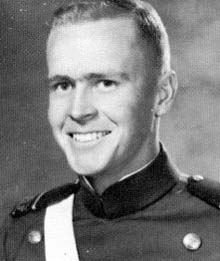
Larry Lynn Severson
"Larry"

Biography as of Feb 28, 2013
I am Larry Severson. I was born in a private home on 20 November 1939. The doctor arrived 2 hours later. I lived in Los Angeles until I enlisted in the service in 1958.
One of my first words, according to my mother was airplane. I always wanted to fly. Growing up, UI read a lot about West Point and Annapolis. Both sounded fantastic, but were forgotten as soon as AFA was build. Arrival there on the bus was one of the highlights of my life. "Oh boy!" was my reaction all through the "hit it for 20" during the signing in activities.
My academic career was interesting. I was able to validate several courses for my first year. this enabled me to take a number of classes that I would probably not taken otherwise. I also overloaded most semesters getting a peak of 27.5 units.
The most difficult choice I made as a cadet was skipping jump school. I did this because I had broken my wrist playing football.
My most memorable experience at the Academy was being selected to create the cover for the 1961 Polaris year book.
The time at USAFA broadened my vision and taught me to question everything, esp[ecially those facts that seemed most accepted.
The greatest challenge that I faced as a cadet was dropping freshman football during Doolie summer. I was not doing well on the obstacle course and feared failing it. After dropping football, my time on the OC dropped so much that I was one of those who were rewarded with a trip to the cadet store for ice cream. Maybe I shouldn't have quit.
My biggest challenge in life was leaving the service due to family problems.
USAFA provided structure and discipline which has enabled me to make difficult decisions all of my life. It has given me the confidence to question authority when I was sure it was wrong.
The greatest lessons that were taught at USAFA were to not assume everything was known. As one the ME instructors said, responding to the question as to the currency of what we were learning, "It takes 7 years for a new practice to be become generally accepted, 7 years to get into a textbook, and 7 years for the books to hit the classes. Sop, everything that you are studying is at least 21 years out of date. However, we are teaching you how to discover what is need to become current." What better lesson can one learn?
Effective leadership consists of getting a group of people moving in the desired direction and performing at the best of their ability.
Moral courage consists of taking a stand that is contrary to the accepted norm. My 3 millitary heroes, Billy Mitchell, Claire Lee chennault, and george Patton, all demonstrated this. They were willing to face court martial, demotions, and transfers because they stood up to the battleship admirals and artillery generals. They were also proved correct by history.
People typically fall short in their efforts to balance character and leadership because they are afraid to voice objection to orders that they know are wrong or defective. None of my 3 heroes would have ordered the "charge of the light brigade", or sent the 900,000+ troops who died because they were sent over the top into the machine guns at Verdun. In fact, Patton, in WWI was ordered to bury 3 valuable tanks and use them as artillery pieces. Instead, he mounted troops on them, charged through the line and captured a German command post 30 miles behind the lines.
I did not get into combat (though I did get shot at flying MAC trips into Saigon and Da Nang). However, the outstanding and broad education has paved the way for me to pass through a number of difficult transitions.
1963 was a special class simply because it was the first to complete all 4 years at the academy site. It is a matter of pride.
the person with the greatest impact during my time at AFA is simple.I was able to tke the 4 semester math curriculum in 3 semesters, but each semester I started out with an instructor who left me with a failing grade at mid term. I was then transferred in to the class with Maj John Saxxon each time. he brought my final grade up to C+.. I had a lot of fun taking extra courses, but I was not a great student because I was going to be a pilot!
The most important thing for a cadet to learn is "cooperate and graduate". Mo organization, especially military, is successful unless all of the members are working together to achieve the common goal, victory.
Most people do knot know that I was one of the first 100 people in the world SCUBA certified (LA County, May 1957). [I found out 30 years later from my actual instructor.]
My integrity was challenged in 1983 when Continental Airlines declared bankruptcy (with $250 million in the bank). I had watched the maneuvering leading up to the event. Falling back on the cadet honor code (I will not lie, steal, or cheat, or tolerate those who do), I left the job that I loved. I did not know how I would feed my family. Luckily, I was able to gather up AFA lessons and get a job in aerospace as an engineer. later I was recommended for full membership in the Human Factors Society, and get my MS in Computer Science.
I owe a lot to the Academy.
35th Reunion (1998): PREMISE: The impossible is more fun. I came from a broken home (age 3) with no connections. It took three tries to get to the Academy. The discipline and pace was enjoyable there. Unfortunately, family problems got me out of the Air Force. I next tried airline work. The flying was a professional pleasure. Unfortunately, I could not remain a captain and work for someone I considered not up “To The Code�. So, I left the flying game and became an engineer in aerospace. I had jobs as a senior project engineer in an advanced simulator research lab (Hughes) and as a senior systems engineer in an advanced projects group (Lockheed). In aerospace, I found that an advanced degree in Computer Science would help. I also find computers a good substitute for flying. In 1968, I went back to school. I worked full time while I sought the MSCS. I was seldom home more than six hours straight for three years. Finally I completed the degree. This got me home every night for the first time in my 20+ years of marriage. I discovered what had kept me married; I got divorced. I was able to get a job as an MTS-6 at Rockwell and later as a program manager at Image Data because of my studies. But, finally, aerospace left me, or was it the other way around. Anyway, in 1990, I married a friend. She hated my long commutes. In 1991, we went into business publishing educational materials for elementary students that work. My new wife, Leigh, saw her students blossom using new materials, winning 9 state and national awards in three years in a NASA science contest. Now that six years, almost seven, have past, I am having a great time in life and it looks like success is around the corner. If I can’t save the world for democracy, maybe I can help save the education of the country. Visit us at: www.macropress.com or send E-Mail to science@macropress.com. EDUCATION: 1986-88: California State University, Fullerton, MS Computer Science 1965-66: American International College, Chicopee, MA, Work towards M.Ed (6 semester units) 1959-63: USAF Academy, Colorado Springs, CO, BS